
Achieved at : 2026-09-06
Rank : 1
(world record)
Lups : 100
Approved :
Yes
Voting completed : 2026-09-13
| General Rules: |
Play with default settings unless otherwise specified. No use of trainers, cheats, saved game files, auto-fire (when not default present in-game), emulator save states, or other emulator advantages. No use of code modifications that give the player an advantage over other players. 1 player only. No continues. It is discouraged and may lead to voters not accepting your score to - excessively point farm - use glitches or other game exploits |
| Specific Rules: | Play the game in 1 player mode , selecting Cave A/1 at the start. |
To vote or comment on this score, please
login.


@Luigi Ruffolo 🇮🇹
TGP
Thank you. Your turn (I'm not good at Boulder Dash and not very keen on it).

TGP
Boulder Dash is a scrolling maze arcade game for the BBC Micro. It was released by Tynesoft in 1988 and written by Andrew Bennett.
This is a port to the BBC Micro of the classic Atari 400/800 game that was released by First Star Software in 1984. That original game was written by Chris Gray and Peter Liepa, and was inspired by Chris playing the 1981 arcade game The Pit. The Pit was a game I remember well, as I used to play it at my local swimming baths. Boulder Dash became the first of a new genre of similar games, BBC owners will best remember the classic Repton series for example. Although earlier games like The Pit, and of course Dig Dug, used a similar mechanic of digging and falling rocks, Boulder Dash was the first to focus on puzzle solving as the main game element.
In Boulder Dash, you play the part of Rockford, a small, vaguely humanoid, being. Rockford has entered a series of caves in a quest to collect diamonds. He can dig through the earth to reach them or use the tunnels which already exist. There are brick walls which cannot be crossed and scattered around are boulders. The boulders are a key mechanic as they will fall if undermined. You can stand under them initially without damage, but if one falls from above, it will kill Rockford. Boulders can also be pushed if there is a clear space behind them. Understanding how boulders work and how to manipulate them, especially when they fall in clusters, is essential to solving each level successfully.
Once Rockford collects the required number of diamonds, the level exit becomes accessible and entering it takes you on to the next cave. There are 16 caves, marked A to P, along with 5 skill levels. The higher skill levels introduce shorter level times and faster speeds, so they do make a difference to the gameplay.
Obstacles to your progression include the clock that counts down, and deadly-to-the-touch fireflies (which explode if crushed by a boulder) and butterflies (which also explode if destroyed, but release a grid of nine diamonds as well). Another 'enemy' is the amoeba. This is not deadly to touch, but will slowly grow, filling any spaces and tunnels it finds which could leave you trapped. Block it in to an area and it will suffocate, releasing a mass of diamonds. If it gets too big, instead of turning into diamonds, it will turn into a mass of boulders instead.
Graphically, the game resembles the original closely, apart from the colour scheme, which is an unusual blend of bright and clashing colours on several screens. On some screens, this can be quite overpowering and can become a distraction - take Screen C as an example. Scrolling could be a little smoother as well, but it is not too much of a distraction. Sound is minimal, although that is less important than in most games as it is nice to be able to have the peace and quiet to concentrate. The biggest issue with this game is the controls. These can be oversensitive and sometimes when you move, you find yourself moving a couple of spaces instead of one. In a game where accuracy of positioning is everything, this can be annoying and can cost you lives unnecessarily. It is a shame about this as otherwise this is a pretty reasonable conversion of the original. The game is definitely overshadowed by the Repton series, which has a more detailed set of graphics and more interesting puzzles, but it is still nice to see the origin Boulder Dash did get a BBC conversion.
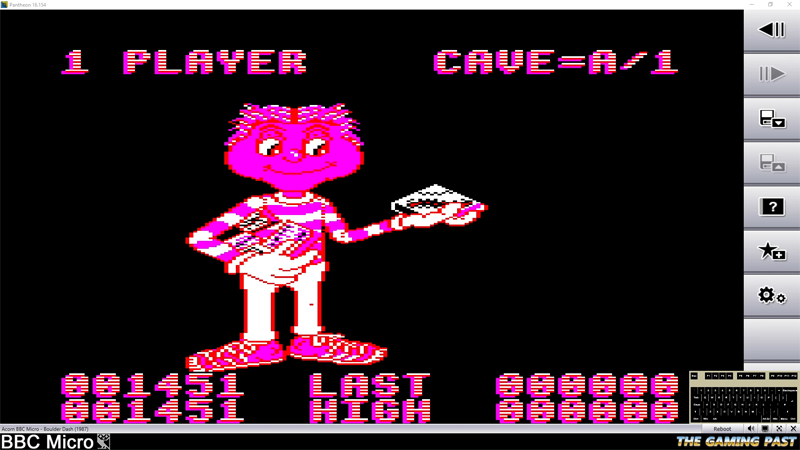
This run was made on the 6th September 2026 using the Pantheon emulator on PC. Level A, Skill 1 was selected. The final score reached was 1,451 points.
Time stamps:
00:30 Game loading.
00:44 Game start, Cave A/1.
02:53 Cave A/1 complete.
03:54 First life lost.
04:17 Extra life awarded for passing 500 points.
06:38 Cave B/1 complete.
06:47 The first cave with a really garish colour scheme.
09:00 Second life lost.
10:26 Third life lost.
10:41 Extra life awarded for passing 1,000 points.
12:07 Fourth life lost.
16:05 Fifth life lost. Game Over! Final score 1,451 points.
This is a port to the BBC Micro of the classic Atari 400/800 game that was released by First Star Software in 1984. That original game was written by Chris Gray and Peter Liepa, and was inspired by Chris playing the 1981 arcade game The Pit. The Pit was a game I remember well, as I used to play it at my local swimming baths. Boulder Dash became the first of a new genre of similar games, BBC owners will best remember the classic Repton series for example. Although earlier games like The Pit, and of course Dig Dug, used a similar mechanic of digging and falling rocks, Boulder Dash was the first to focus on puzzle solving as the main game element.
In Boulder Dash, you play the part of Rockford, a small, vaguely humanoid, being. Rockford has entered a series of caves in a quest to collect diamonds. He can dig through the earth to reach them or use the tunnels which already exist. There are brick walls which cannot be crossed and scattered around are boulders. The boulders are a key mechanic as they will fall if undermined. You can stand under them initially without damage, but if one falls from above, it will kill Rockford. Boulders can also be pushed if there is a clear space behind them. Understanding how boulders work and how to manipulate them, especially when they fall in clusters, is essential to solving each level successfully.
Once Rockford collects the required number of diamonds, the level exit becomes accessible and entering it takes you on to the next cave. There are 16 caves, marked A to P, along with 5 skill levels. The higher skill levels introduce shorter level times and faster speeds, so they do make a difference to the gameplay.
Obstacles to your progression include the clock that counts down, and deadly-to-the-touch fireflies (which explode if crushed by a boulder) and butterflies (which also explode if destroyed, but release a grid of nine diamonds as well). Another 'enemy' is the amoeba. This is not deadly to touch, but will slowly grow, filling any spaces and tunnels it finds which could leave you trapped. Block it in to an area and it will suffocate, releasing a mass of diamonds. If it gets too big, instead of turning into diamonds, it will turn into a mass of boulders instead.
Graphically, the game resembles the original closely, apart from the colour scheme, which is an unusual blend of bright and clashing colours on several screens. On some screens, this can be quite overpowering and can become a distraction - take Screen C as an example. Scrolling could be a little smoother as well, but it is not too much of a distraction. Sound is minimal, although that is less important than in most games as it is nice to be able to have the peace and quiet to concentrate. The biggest issue with this game is the controls. These can be oversensitive and sometimes when you move, you find yourself moving a couple of spaces instead of one. In a game where accuracy of positioning is everything, this can be annoying and can cost you lives unnecessarily. It is a shame about this as otherwise this is a pretty reasonable conversion of the original. The game is definitely overshadowed by the Repton series, which has a more detailed set of graphics and more interesting puzzles, but it is still nice to see the origin Boulder Dash did get a BBC conversion.
This run was made on the 6th September 2026 using the Pantheon emulator on PC. Level A, Skill 1 was selected. The final score reached was 1,451 points.
Time stamps:
00:30 Game loading.
00:44 Game start, Cave A/1.
02:53 Cave A/1 complete.
03:54 First life lost.
04:17 Extra life awarded for passing 500 points.
06:38 Cave B/1 complete.
06:47 The first cave with a really garish colour scheme.
09:00 Second life lost.
10:26 Third life lost.
10:41 Extra life awarded for passing 1,000 points.
12:07 Fourth life lost.
16:05 Fifth life lost. Game Over! Final score 1,451 points.